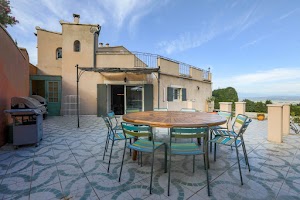

Some dishes need almost nothing to be unforgettable. The Ardèche crique is one of them: a few potatoes, a little garlic, some parsley, a hot pan — and that is all. After ten years welcoming our guests at Mas Saint Antoine, we have noticed that many leave wanting to recreate at home what they tasted here. The crique is one of those recipes: simple, generous, and deeply Ardèche. Here is our complete 2026 guide to understanding it, getting it right and knowing how to enjoy it.
What exactly is the Ardèche crique?
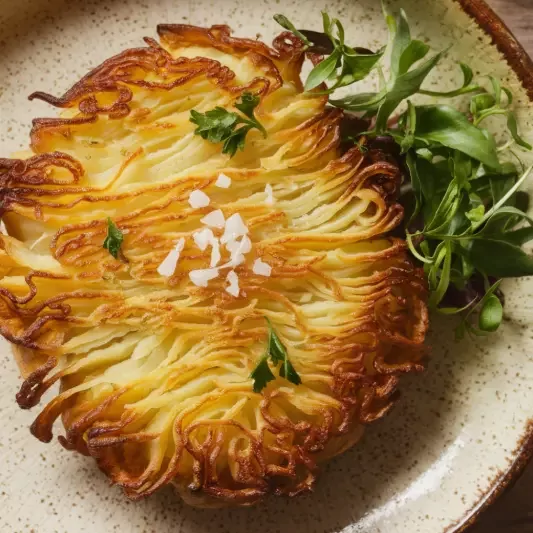
The Ardèche crique is a cake of raw grated potatoes, pan-fried golden in a little fat. Crisp on the outside, soft on the inside, it is eaten hot, as a main course or as a side dish.
Its distinctive feature lies in one essential detail: in the Ardèche, the traditional recipe uses raw potatoes, grated then wrung out — not pre-cooked. This is what gives it its unique texture. It is sometimes compared to the Swiss rösti or the “hash brown”, but the crique has its own identity: its garlic and parsley seasoning, and above all its Ardèche peasant history.
What is the history of the Ardèche crique?
The crique was born from the peasant cuisine of the Ardèche. Regional sources place its roots in the early 20th century: at that time, modest families grew their own potatoes and looked for economical, filling recipes to feed those working in the fields. The crique met that need perfectly — rustic, satisfying, made with always-available ingredients.
According to regional cookbooks, the Ardèche crique was already mentioned in local recipe books from the early 20th century. Tradition has it that grandmothers prepared it early in the morning: the cake, slipped into a clean cloth, kept its warmth until the meal taken out in the fields. From a dish of necessity, the crique thus became, over the generations, a symbol of conviviality and sharing — a dish now made for pleasure rather than obligation.
What is the traditional recipe for the Ardèche crique?
The strength of the Ardèche crique is its simplicity. Here is the traditional recipe, for about 4 people.
Ingredients
- 1 kg of potatoes with floury flesh (Bintje or Mona Lisa type)
- 2 to 3 cloves of garlic
- 1 bunch of fresh parsley
- 2 eggs (optional, to bind the cake)
- Salt, pepper
- Olive oil for cooking (some prefer butter or duck fat)
- A little flour (optional, to help it hold together)
Preparation steps
- Grate the raw potatoes: peel them, then grate them — finely for more crispness, or coarsely for a more rustic texture.
- Wring out, the crucial step: place the grated potatoes in a clean cloth and twist it firmly over the sink to extract as much water as possible. The less water remains, the more golden and crisp the crique will be.
- Season: mix the potatoes with the chopped garlic, the chopped parsley, salt and pepper. Add the eggs and a little flour if you wish.
- Cook: heat the oil in a pan, spread the mixture to form a cake. Let it brown over medium heat, then turn it to cook the other side.
- Serve immediately: the crique is eaten hot, straight from the pan, while still crisp.
Summary table
| Item | Information |
|---|---|
| Type of dish | Potato cake, main course or side dish |
| Potatoes | Raw, grated, well wrung out — floury variety |
| Preparation time | About 20 minutes |
| Cooking time | About 15-20 minutes |
| Difficulty | Easy |
| Best eaten | Hot, straight from the pan |
What do you eat the Ardèche crique with?
This is one of the great qualities of the Ardèche crique: it is versatile. Here is how our guests most often enjoy it.
As a main course
Served on its own with a simple dressed green salad, the crique makes a complete and comforting meal. A piece of fresh goat’s cheese alongside — a picodon, for instance — and there you have it: an authentic Ardèche lunch.
As a side dish
The crique goes wonderfully with grilled meats, roasts or a slow-cooked daube. It is a delicious alternative to plain potatoes and brings that crispness that pleases everyone, young and old.
With a caillette
It is a pairing the people of the Ardèche know well: crique and Ardèche caillette on the same plate. The softness of the chard caillette and the crispness of the crique complement each other perfectly — a duo of local specialties for a fully Ardèche meal.
Which wine with the crique?
The crique calls for a simple, unpretentious wine. A chilled rosé pairs very well with its rustic character, as does a light red. No need to open a great bottle: the crique is a dish for sharing, and the wine should be too.
What mistakes should you avoid to succeed with your crique?
- Not wringing out the potatoes. This is mistake number one. A crique full of water will never brown properly and will stay soft. Press firmly in a cloth.
- Using pre-cooked potatoes. The traditional Ardèche crique is made with raw potatoes. Pre-cooking them completely changes the texture.
- A pan that is not hot enough. The fat must be properly hot before adding the mixture, otherwise the cake sticks and does not crisp up.
- Making the cake too thick. Too thick, the crique cooks poorly in the middle. Better a cake of reasonable thickness, even if it means making several.
- Letting it wait. The crique is eaten right away. Reheated, it loses its crispness — it is a pleasure of the moment.
Where to taste the Ardèche crique during your holiday?
If you stay in the southern Ardèche, you will find the crique on many menus of restaurants and country inns, especially in establishments that showcase traditional cuisine. Local markets — such as the one in Bourg-Saint-Andéol, five minutes from Mas Saint Antoine, on Wednesday and Saturday mornings — are also the chance to find good local potatoes to make it yourself. And perhaps that is the best part: the crique is so simple that it is ideal for a convivial dinner with friends or family, in the kitchen of your cottage.
Why stay at Mas Saint Antoine to discover Ardèche cuisine?
- ✅ 5 minutes from the Bourg-Saint-Andéol market (Wednesday and Saturday mornings) for your local produce.
- ✅ Equipped kitchens in all the cottages — ideal for cooking crique, caillette and other local specialties.
- ✅ 6 independent accommodations for 2 to 10 people, on a peaceful 2-hectare estate.
- ✅ Rated 4.9/5 from 137 verified reviews and selected by Petit Futé 2026.
- ✅ Ideal for groups: the estate can be privatised for 20 to 38 people — perfect for a gourmet weekend with extended family around a large table.
Discover our accommodations on the our rooms and cottages page, or browse our other food guides in Le Mag du Mas.
In conclusion
- The Ardèche crique is a cake of raw grated potatoes, pan-fried until golden.
- It comes from the Ardèche peasant cuisine of the early 20th century.
- The secret to success: wring out the grated potatoes well.
- It is eaten hot, as a main or a side, and pairs wonderfully with a caillette.
- Simple and convivial, it is the ideal recipe to make in the kitchen of your cottage.
Some recipes cross the generations without losing any of their charm. The Ardèche crique is one of them: a humble dish, born of necessity, that has become a real joy of sharing. A must to try during your next stay in the Ardèche.
Frequently asked questions
What is the Ardèche crique?
The Ardèche crique is a cake of raw grated potatoes, pan-fried until golden. Crisp on the outside and soft on the inside, it is seasoned with garlic and parsley. It is a specialty of Ardèche peasant cuisine, eaten hot as a main course or a side dish.
How do you make a crisp Ardèche crique?
The secret is to carefully wring out the grated potatoes in a clean cloth, to extract as much water as possible. You also need a pan with properly hot fat, and a cake that is not too thick. The less water remains, the more the crique browns and crisps up.
What do you eat the Ardèche crique with?
The crique is eaten as a main course with a green salad and goat’s cheese, or as a side with grilled meats, roasts and daubes. People in the Ardèche also enjoy it with a caillette. For wine, a chilled rosé or a light red accompany it very well.
Do you need raw or cooked potatoes for the crique?
The traditional Ardèche crique is made with raw potatoes, grated then wrung out. This is what gives it its characteristic texture. Pre-cooking the potatoes completely changes the result and moves away from the authentic recipe.
What is the origin of the Ardèche crique?
The crique comes from the peasant cuisine of the Ardèche. Regional sources place its roots in the early 20th century: modest families made it as an economical, filling dish for those working in the fields. It later became a symbol of conviviality.
What is the difference between an Ardèche crique and a rösti?
Both are pan-fried grated potato cakes, and they look very similar. The Ardèche crique stands out for its garlic and parsley seasoning and its roots in Ardèche peasant tradition. This type of cake is sometimes called a “hash brown”.
Which potato variety should you choose for the crique?
Favour a floury-fleshed potato, such as Bintje or Mona Lisa. These varieties hold up well when cooked as a cake and give a texture that is both crisp and soft.
Can the Ardèche crique be eaten cold?
The crique is best enjoyed hot, straight from the pan, while still crisp. Reheated or eaten cold, it loses much of its texture. It is a pleasure of the moment, to be enjoyed without delay.
Can you make the crique for a large group?
Yes, the crique is ideal for convivial meals: the recipe is simple and economical. For a large group, it is better to cook several successive cakes rather than one very thick one, to keep the crispness. It is a perfect dish for a large table in a cottage.
Where can you taste the Ardèche crique in the Ardèche?
The crique appears on many menus of restaurants and country inns in the southern Ardèche, especially in traditional-cuisine establishments. You can also buy good local potatoes at local markets, such as the one in Bourg-Saint-Andéol, and make it yourself.
Avis google