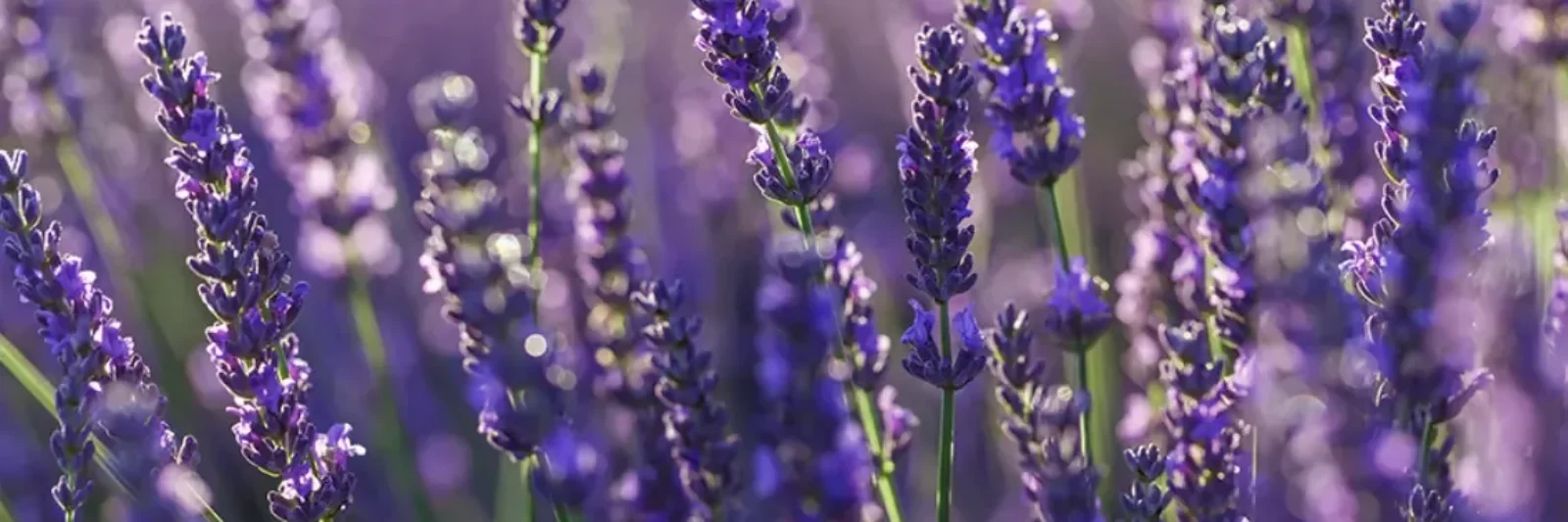

There’s a moment of the year when southern Ardèche takes on the look of deep Provence: lavender bloom. Every summer, from mid-June to mid-July, the limestone plateau between Gras, Larnas, Saint-Remèze and Bidon is covered with long purple waves rippling in the south wind. It’s the only sector of the department where lavender is grown — and it’s a few minutes from Mas Saint Antoine.
As hosts (and amateur photographers of Ardèche landscapes), we are often asked where to shoot the most beautiful images. Here are our 5 favorite spots, all verified, all accessible, with our light and timing tips.
When to photograph lavender in Ardèche?
The bloom period
Lavender blooms in southern Ardèche between mid-June and mid-July. The color peak is generally around the last week of June and the first of July. Harvest then starts, often late July depending on the year’s weather: once the fields are cut, it’s over until next year. If lavender is your goal, aim for late June to mid-July.
The ideal hour
Like any landscape, lavender is best photographed during golden hours: early morning (from dawn to about 9am) and late day (from 6-7pm to sunset). At these times:
- Light is warm and grazing, it highlights the rows
- Lavender purple is more saturated than in midday sun
- There are fewer people and fewer cars in the fields
- Wind is generally calmer in the morning (useful for sharpness)
Midday should be avoided: hard light, washed-out colors. Reserve that slot for visiting the Maison de la Lavande (in the shade).
The responsible reflex
Lavender fields are private agricultural farms, not sets. Never trample the rows, don’t pull stems, don’t lie down in the plants. Photograph from the edges, paths and roads. Lavender also feeds many bees and butterflies: we look, we don’t disturb.
Spot 1 — The heart of the Saint-Remèze plateau
About 15 minutes from Mas. This is THE lavender spot of Ardèche, the largest and most accessible. Around the village of Saint-Remèze, on the limestone plateau, stretch the largest lavender parcels of the department. The fields directly border several small roads: you easily photograph from the edge without entering the parcels.
Our tip
Look for fields planted in regular lines: these are the best compositions, as the rows create vanishing lines that guide the eye. Place an element at the vanishing point (a stone hut, an isolated tree) to structure the image. Morning light is ideal here.
Spot 2 — The Laoul plateau between Larnas and Gras
About 20 minutes from Mas. Between the villages of Larnas and Gras, the Laoul plateau offers a more intimate, rolling landscape, where lavender mixes with vines and capitelles (those small dry-stone constructions typical of Ardèche garrigue). It’s a less frequented sector than Saint-Remèze, perfect for original compositions.
Our tip
The dry-stone capitelles in the middle of fields are golden photo subjects: they bring a heritage point of interest and texture contrast. Also look for lavender + vine row alignments.
Spot 3 — The summit of the Dent de Rez
Hike start about 25 minutes from Mas (Saint-Vincent hamlet in Gras). For walkers, the Dent de Rez (719 m, highest point of southern Ardèche) offers an absolutely grandiose 360° panorama. The climb crosses lavender fields, and from the summit the view extends from the Cévennes to the Dentelles de Montmirail.
Our tip
This is the spot for wide landscape photos: from the heights, lavender fields become color patches in an immense landscape. Allow a 3h to 3h30 hike (loop), bring water, a hat and good shoes. Leave early morning for soft light AND to avoid the heat of the climb.
Spot 4 — The Romanesque church of Larnas
About 20 minutes from Mas. The small village of Larnas has a beautiful Romanesque church whose setting invites a photo break with, in the background, the lavenders and vines of the Laoul plateau. It’s a more ‘postcard’ spot: it combines built heritage and agricultural landscape.
Our tip
Play on compositions combining a lavender foreground and the church in the background. The Romanesque stone takes beautiful warm tones at end of day — the spot to favor for evening light.
Spot 5 — The Maison de la Lavande in Saint-Remèze
10 minutes from Mas. The Maison de la Lavande – Domaine Lavandaïs deserves its place in this top 5 for a simple reason: its lavender fields and garden are free and open access, and the estate itself indicates ‘Photos strongly recommended’. It’s the safest and simplest spot: no need to search for a field, it’s landscaped and maintained.
Our tip
It’s the ideal spot with family or if you’re a beginner: everything is easy to access, there’s shade, free parking and even an ice cream parlor. Take the opportunity to do the guided museum tour (Little Train, distillation): we wrote a complete guide to the Maison de la Lavande.
Summary of the 5 spots
| Spot | Distance from Mas | Access level | Best light |
|---|---|---|---|
| 1. Saint-Remèze plateau | 15 min | Easy (roadside) | Morning |
| 2. Laoul plateau (Larnas-Gras) | 20 min | Easy (small roads) | Morning or evening |
| 3. Dent de Rez summit | 25 min + 3h hike | Sporty (hike) | Morning |
| 4. Larnas Romanesque church | 20 min | Easy | Evening |
| 5. Maison de la Lavande | 10 min | Very easy (landscaped) | Morning or evening |
Our technical tips for successful lavender photos
- Look for lines: lavender rows are natural vanishing lines. Position yourself along the rows for depth.
- A point of interest: a lavender field alone can be monotonous. Add an isolated tree, a capitelle, a church, a silhouette.
- The foreground: lower the camera to flower level for an immersive sharp lavender foreground.
- Rule of thirds: place the horizon on the upper third (to value lavender) or lower third (to value the sky).
- Golden hour mandatory: lavender shot at noon is washed out. Early morning or evening, always.
- Wind: lavender moves. For sharp stems, raise shutter speed (1/500s+). For artistic motion blur, lower it deliberately.
- Polarizer: a polarizing filter intensifies the purple and sky blue, reduces leaf reflections.
- Smartphone: even without a DSLR, portrait mode or a low frame with foreground works very well.
A typical lavender photo day from Mas Saint Antoine
- 6:30-7am — Wake and departure for the Saint-Remèze plateau (dawn light)
- 7-9am — Photo session on the plateau and Laoul during golden hour
- 9:30am — Return to Mas for breakfast on the terrace
- 10:30am-12:30pm — Visit the Maison de la Lavande (cool, shaded)
- Afternoon — Nap, 13×6 m saltwater pool, rest during hot hours
- 6:30-9pm — Second photo session: Larnas church and Laoul plateau in evening light
Why stay at Mas Saint Antoine to photograph lavender?
The Mas Saint Antoine, in Bourg-Saint-Andéol, is ideally located for lavender photography enthusiasts: the lavender plateau is 15-25 minutes away, and the Maison de la Lavande only 10 minutes. Staying on site allows leaving before dawn for golden hours and returning for a nap during hot hours.
We welcome:
- Families and couples in our 6 independent rural gîtes
- Groups and events with estate privatization for 20 to 38 people
- Corporate seminars outside July-August
Selected by Petit Futé 2026, rated 4.9/5 on 130+ reviews, Mas Saint Antoine combines a large 13×6 m saltwater pool, 2-hectare private park, views of Mont Ventoux and the Dentelles de Montmirail.
To book your stay during lavender season: +33 6 68 11 48 71 or via our group quote form.
Frequently asked questions
When does lavender bloom in Ardèche?
Lavender blooms in southern Ardèche between mid-June and mid-July, with a color peak around the last week of June and first of July. Harvest generally starts late July depending on weather. To photograph fields in bloom, aim for late June to mid-July.
Where to see lavender fields in Ardèche?
The lavender plateau, between Gras, Larnas, Saint-Remèze and Bidon, is the only sector of the department where lavender is grown. Our 5 favorite spots: the heart of the Saint-Remèze plateau, the Laoul plateau between Larnas and Gras, the Dent de Rez summit, the Larnas Romanesque church and the Maison de la Lavande in Saint-Remèze.
What time to photograph lavender?
Golden hours are ideal: early morning (dawn to 9am) and end of day (6-7pm to sunset). Warm grazing light saturates the purple and highlights the rows. Avoid midday: hard light and washed-out colors.
Can you enter lavender fields for photos?
No. Lavender fields are private agricultural farms. Never trample the rows, pull stems or lie down in the plants. Photograph from edges, paths and roads. Lavender also feeds many bees and butterflies to respect.
Do you need a professional camera?
No, a recent smartphone gives excellent results on lavender. What matters is light (golden hours) and composition (vanishing lines of rows, point of interest, immersive foreground). A polarizing filter helps intensify colors if you have a DSLR.
Is the Dent de Rez accessible to everyone?
The Dent de Rez (719 m) requires a 3h to 3h30 loop hike with elevation gain. It’s not suitable for young children or unfit people. Bring water, a hat and good shoes, and leave early morning. For an easy option, prefer the Saint-Remèze plateau accessible by car.
Which lavender spot for families with children?
The Maison de la Lavande in Saint-Remèze is the most family-friendly spot: free open-access fields, parking, shade, artisan ice cream and the option to combine with the guided museum tour. The Saint-Remèze plateau accessible by car is also easy with children.
How far are the lavender fields from Mas Saint Antoine?
The lavender spots are all close to Mas Saint Antoine: the Maison de la Lavande 10 minutes, the Saint-Remèze plateau 15 minutes, the Laoul plateau (Larnas-Gras) 20 minutes, the Dent de Rez hike start 25 minutes. Staying at Mas allows leaving before dawn and returning during hot hours.
Mas Saint Antoine is available year-round. For a photo stay during lavender season from one of our 6 gîtes or in estate privatization for 20 to 38 people: +33 6 68 11 48 71.
Avis google

Le logement est nickel, très agréable et parfaitement entretenu\. La piscine est top, un vrai bonheur pour profiter et se détendre \! ☀️🏊♀️
Les conseils pour les activités et les visites étaient vraiment hyper adaptés à nos envies, ce qui nous a permis de découvrir de très chouettes endroits\. Le lieu est vraiment sympa, calme et agréable\.
Une adresse que nous recommandons les yeux fermés \+\+\+ \! Merci encore pour cet accueil et ce super séjour, nous reviendrons avec grand plaisir \! 😊
Famille Descampiaux

Nous qui souhaitions nous reposer et prendre du bon temps, nous avons été plus que servis.
Notre chalet "lavande", proposait tout le nécessaire, à l ombre des arbres, nous avons pu nous détendre bercés par le chant des cigales.
Après les activités sportives, visites...quel bonheur de venir se rafraîchir dans cette magnifique piscine.
Nous avons vraiment apprécié l'accueil et la gentillesse de nos hôtes.
Quel bonheur de ne pas se soucier de draps, de serviettes, torchons....
En bref, pari réussi, du repos, des activités et de la convivialité...
Merci pour ce beau séjour et ces échanges.
Nous reviendrons !
Élisabeth et Patrick.

Le gîte est top, conforme à la description.
Les propriétaires sont très sympas et de très bons conseils pour les visites, les restos et activités à faire aux alentours.
Nous sommes venus avec notre chien qui a pu se déplacer librement dans la propriété, en toute sécurité.
Location à recommander !

Un très bon accueil des propriétaires.
Des prestations ( paella, canoë....),que nous avons tous apprécié.
Des couchages confortables.
Nous reviendrons avec grand plaisir.
Merci

Concernant les hébergements et les infrastructures, tout est parfait. On ne manque de rien et le lieu est magnifique.
Encore merci pour ce week-end qui fût des plus agréable !

Le domaine est superbe, très bien entretenu, au calme, au cœur de l’Ardèche méridionale, avec une vraie ambiance conviviale et familiale. Les différents gîtes permettent à chacun d’avoir son espace tout en gardant un vrai lieu de rassemblement pour partager les repas et les activités.
Un immense merci également aux propriétaires pour leur disponibilité, leur écoute et leur gentillesse tout au long de l’organisation. Nous avons été très bien accompagnés avant le week-end avec de nombreux conseils utiles, aussi bien pour les prestataires que pour l’organisation générale de l’événement.
Tout a été simple, fluide et agréable. Les recommandations données sur place étaient excellentes et nous ont permis de construire un week-end vraiment réussi.
Le cadre est idéal pour ce type de rassemblement familial ou amical : piscine, nature, tranquillité, nombreux hébergements et beaucoup d’activités à faire dans les environs.
Nous gardons un très beau souvenir de ce week-end et nous recommandons le Mas Saint-Antoine sans hésitation.
**La seule petite contrainte du week-end concerne la gestion des déchets, puisqu’il n’y a pas encore de bacs d’ordures ménagères ou de tri directement sur le domaine et qu’il faut se rendre au village. Cela ne nous a pas posé de véritable problème, mais ce serait un vrai plus à l’avenir.


Bref un endroit au top que nous recommandons vivement

Le lieu est magnifique, avec une très belle vue et très calme.
La propriétaire a été charmante et à l'écoute de nos besoins quels qu'ils soient; un climat de confiance s'est vite installé.
Le lieu est très accessible et les parties communes pour se réunir sont très bien équipées.
La literie est bonne et les chambres propres.
Je recommande

Le cadre extérieur est également très appréciable : piscine, forêt, ping-pong, terrain de pétanque et grande terrasse pour profiter encore un peu du soleil d’automne ☀️
Merci Hélène et Bernard pour votre accueil chaleureux!
Merci également au traiteur So’ brunch de nous avoir livré à domicile pour régaler nos papilles tout le week-end!
Une expérience réussie! 🥳

L'espace piscine est vraiment super avec des nombreuses assises si vous êtes un grand groupe.
Tous les gîtes sont très propres et très bien équipés. Pas de plaintes des invités sur la literies en tout cas! Petit plus : les lits étaient fait à l’arrivée et les serviettes à disposition sur les lit.
Nous avons pu également voir de superbes couchés de soleil sur la vallée. Sans oublier la vue dégagée sur le mont ventoux.
Une très chouette adresse : j’y retournerai avec grand plaisir ! Pourquoi pas les 35 ans !


Bernard et sa femme sont adorables, humains, serviable et très à l'écoute.
C'est un gîte familial, tranquille et agréable.
Et il n'y a pas de moustiques ! 😅
Nous avons passé un excellent séjour.
Si nous revenons en Ardèche ça sera ici, merci encore pour tout 🙏


Un accueil très chaleureux d’Hélène et Bernard qui nous ont indiqué plusieurs sites à visiter. On n’oublie pas Djingo, le super copain de notre chienne.


Gîte de l’olivier pour notre séjour très propre et très bien équipé , pensez juste au tire bouchon ^^ seule petit bémol pour la personne dormant dans le salon la VMC peut être bruyante pour une personne ayant le sommeil léger sinon rien à redire nous reviendrons si nous passons dans le coin ! Merci pour votre accueil

Patricia et stéphane

Rien à redire! Il nous tarde de revenir.


Notre chien aussi a apprécié le séjour, il a pu navigué à son aise sur le domaine.
Les propriétaires sont très sympathiques et arrangeants.
Nous avons beaucoup aimé notre semaine au Mas et nous recommandons vivement cette adresse.


Je recommande fortement

Logements/cuisines et extérieurs très bien équipés et adaptés aux enfants!
Merci pour l’accueil :-)

Des propriétaires des plus accueillants, toujours à l'écoute de nos remarques et de notre bien être.
Beaucoup d'activités à faire autour du Mas saint antoine
on pense déjà à notre prochain séjour au Mas, c'est un lieu à connaître et à découvrir sans attendre, vous passerez un séjour plus que reposant
merci encore aux propriétaires du Mas Saint Antoine , lieu incontournable

La piscine est juste splendide dans un écrin de verdure.
Quant aux propriétaires ils sont adorables et prêt à vous aider et vous conseiller. Superbe semaine

Nous conseillons le lieu car idéalement situé pour circuler et visiter cette belle région.

Très belle piscine avec pergolas pour éviter les coups de soleil.
Les propriétaires sont à l'écoute,
disponibles et de très bons conseils pour découvrir la région.
Maxime et Laetitia

Les propriétaires sont prévenant
Piscine gîte WiFi dans les chalets
Vue splendide


Nous avons pu partager de très bons moments avec les hôtes, qui sont de très bons conseils sur ce qu'il y a à faire et à découvrir aux alentours.
Le cadre et le logement sont magnifiques, un vrai havre de paix où il fait bon de se retrouver entre amis ou en famille
Le Mas Saint Antoine est idéalement placé pour profiter de toutes les activités touristiques et sportives
La piscine avec vue est sécurisée et splendide, la réalité est conforme aux photos, tout est très bien équipé et choisi avec goût
Merci à nos hôtes pour l'accueil, nous reviendrons avec plaisir !


Très vaste et parfaitement équipé.
Accueil cordial .
Gite à recommander.

Un grand merci aux hôtes qui nous ont très bien reçu. Le cadre du mas saint Antoine est idéal pour des retrouvailles familiales, sécurisé et très bien équipé.
Les gîtes sont décorés avec goût, propres et fonctionnels. La piscine, les terrains de pétanques, la table de ping-pong sont un vrai plus. Nous avons même eu la possibilité de louer un karaoke!
Toute la famille, des petits aux grands garderons un super souvenir de cet endroit. Nous gardons précieusement l’adresse.
Merci beaucoup et à bientôt !
Julie et toute sa famille :)


Les parties de pétanques et de ping-pong a l'ombre des arbres auraient pu durer jusqu'au lendemain si les enfants qui se sont éclatés ne vennaient pas nous interrompre😁.
Nous n'avons pas pu profiter de la piscine car la température ne le permettait pas, mais je ne doute pas que ce doit être un délice en été.
Un seul regret: ne pas avoir été initié par Bernard à la recherche de truffes dans sa truffière privée...😆
Nous reviendrons, c'est certain, et nous vous recommanderons vivement et sincèrement!
Longue vie au Mas St-Antoine et merci Elena et Bernard d'offrir un lieu magique.


Je recommande


I recommend this well located and quiet place.

Logement impeccable, décoré avec goût, et fonctionnel.
Notre petite famille à pu profiter d’un séjour agréable , et dépaysant.
La piscine avec vu imprenable était un très apprécié.
Petit plus: notre chien a pu profiter du voyage également…
Merci à vous.
Romain Juliette et les enfants.

,


Les propriétaires sont extrêmement sympathiques, a l'écoute et très serviables, nous y reviendrons a coup sûr


Une piscine au top du top ,les propriétaires sont très accueillants et sympathique
Nous y reviendrons avec plaisir


Perfect welcome in joy and good humor, beautiful place and the chalets are good. The swimming pool is superb and equipped. The tenants informed us well about the surroundings. This place is magnificent !!!


Nous avons pu profiter de la piscine mais aussi des alentours. Nous regrettons de n’être pas restés davantage pour profiter encore de la région.

