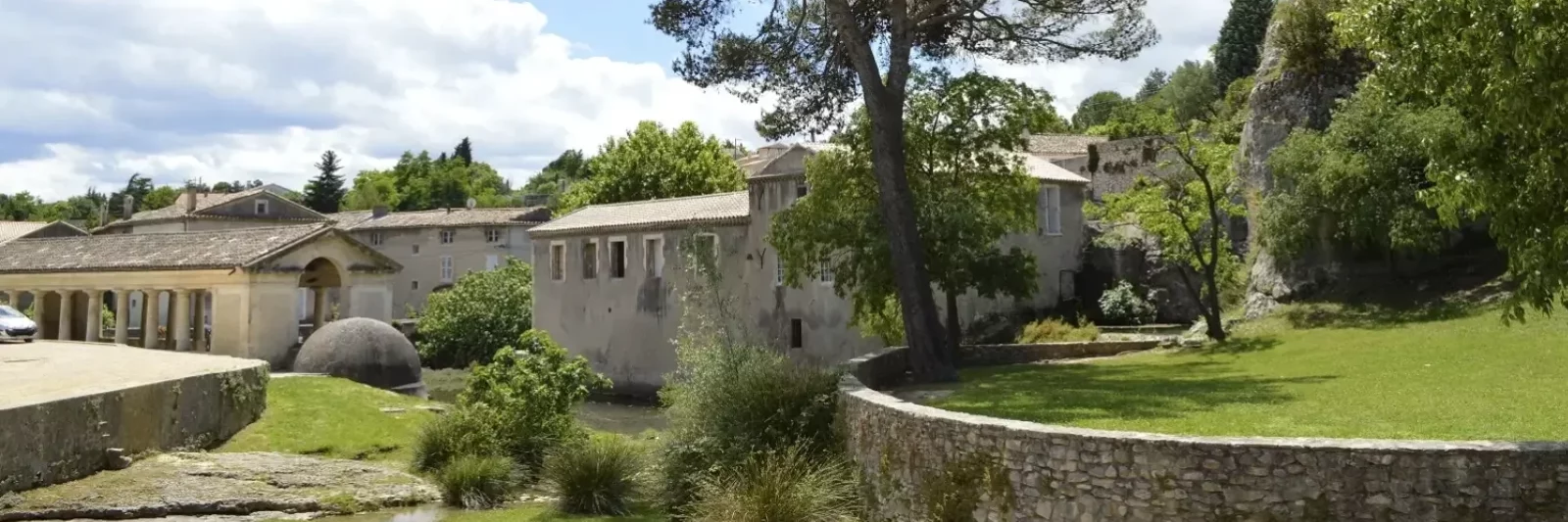

In the very heart of Bourg-Saint-Andéol, there is a place most passers-by walk past without imagining what it hides. On the surface: a peaceful basin of clear water in a park, an old wash-house, an ancient bas-relief. Below: a dizzying abyss, a labyrinth of flooded galleries plunging more than 240 metres deep, and whose bottom has never been found. These are the Gouls de Tourne, one of the world’s greatest cave-diving sites — and it lies five minutes from Mas Saint Antoine. Here is its story.
What are the Gouls de Tourne?
The Gouls de Tourne (locals simply say “Tourne”) are two neighbouring resurgences, located in a park in the centre of Bourg-Saint-Andéol, about a hundred metres apart: the Goul du Pont and the Goul de la Tannerie.
The word “goul” refers here to a Vauclusian-type resurgence: not a simple spring, but the place where an underground river reappears in the open air. Beneath the calm surface lies a whole network of flooded galleries, carved by water into the limestone over millennia — a karst system whose limits have, to this day, still not been reached.
Why is this site known around the world?
The Gouls de Tourne are a world reference for deep cave diving. There are several reasons for this.
First, a striking paradox: a site of extreme difficulty, but with surprisingly easy access. You park in the town-centre park, and the water entry is a few steps away. This accessibility has made it a true “training site” for cave diving, where many specialised divers are trained.
Then, two cavities with complementary profiles: the Goul du Pont, with a shallow horizontal progression followed by a vertical shaft; and the Goul de la Tannerie, about 700 metres of horizontal gallery leading to a dizzying shaft. Each exceeds a kilometre in length and 200 metres in depth — and, remarkably, the two systems have to this day still not joined up.
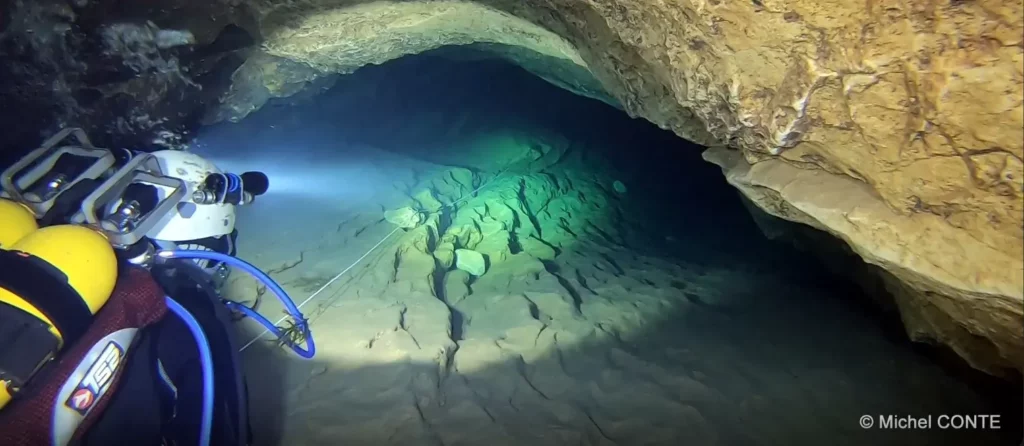
Forty years of world records
The Goul de la Tannerie is one of the world’s great sites for deep cave diving. For more than forty years, the world’s leading cave divers have pushed the depth limits there. A few milestones in this dizzying race:
- 1983 — Bertrand Léger reaches -113 m and draws the first detailed survey.
- 1996 — Olivier Isler descends to -165 m.
- 2004 — Sylvain Redoutey reaches -209 m, the European record of the time.
- 2008 — Britain’s Rick Stanton pushes to -220 m.
- 2014 — Xavier Méniscus reaches -240 m.
- 2019 — Xavier Méniscus goes even deeper, to -243 m.
To grasp the feat: in 2014, to reach -240 metres nearly 1.5 km from the entrance, Xavier Méniscus stayed underwater for more than ten hours. A former combat swimmer and professional diver, he has become the emblematic figure of the site, which he has been exploring since 2002.
Far more than a sporting feat: the town’s water
What makes the Gouls de Tourne even more fascinating is that these explorations have a purpose beyond the record. The work carried out on the site aims in particular to map this huge underground network in order to protect the water resource — because these resurgences actually supply Bourg-Saint-Andéol with drinking water. Searching for the junction between the two gouls, understanding where the water comes from and how it flows: it is also a mission in the service of the town and its future.
Can you dive in the Gouls de Tourne?
Let us be clear: this is not a leisure dive. Deep cave diving is one of the most demanding and committing disciplines there is, reserved for highly specialised and extensively trained divers. It is not an activity accessible to holidaymakers.
Moreover, because of the protection of the drinking-water resource, diving on the site is regulated and subject to a prefectoral order. Before any project, it is essential to check the regulations in force with the competent authorities or the local diving club (the Club de Plongée du Val de Tourne).
But good news: there is no need to dive to enjoy the place. The site is very easy to discover from the surface, and that is what we recommend to our guests.
What is there to see on the surface?
The Tourne valley has been classified as a picturesque site since 1934, and it is worth the walk in itself. On site, you will discover:
- The two basins of clear water of the resurgences, in their green setting — calm on the surface, dizzying below.
- An antique-inspired wash-house, fed by the springs.
- A rare bas-relief dedicated to the god Mithras, one of very few in France — a testimony to the Gallo-Roman past of Bourg-Saint-Andéol.
It is a perfect stop, free and shaded, to combine with a visit to the old town of Bourg-Saint-Andéol and its medieval lanes.
A site five minutes from Mas Saint Antoine
This is the whole appeal for our guests: this exceptional site is only five minutes from Mas Saint Antoine. Whether you are passionate about geology, fond of unusual stories, curious about heritage or simply looking for a pleasant walk, the Gouls de Tourne are a memorable discovery. Imagining that a few metres beneath your feet plunges an abyss whose bottom is unknown has something genuinely fascinating about it.
During your stay, you can continue with the area’s other treasures: the Ardèche gorges, the Chauvet 2 Cave, or the markets of southern Ardèche. Find our accommodations on the our cottages in the Ardèche page.
In conclusion
- The Gouls de Tourne are two resurgences in the centre of Bourg-Saint-Andéol, 5 min from Mas.
- It is one of the world’s greatest deep cave-diving sites (records down to -243 m).
- The gallery network has never been fully explored, and it supplies the town’s drinking water.
- Diving is reserved for specialists and regulated — check before any project.
- The site can be visited on the surface (basins, antique wash-house, Mithras bas-relief): an unusual stop for everyone.
A bottomless abyss in the heart of the town: that is the kind of secret southern Ardèche holds. To be discovered on your next stay at Mas.
Frequently asked questions
What are the Gouls de Tourne?
The Gouls de Tourne are two neighbouring Vauclusian resurgences, the Goul du Pont and the Goul de la Tannerie, located in a park in the centre of Bourg-Saint-Andéol. They are the points where an underground river reappears in the open air, hiding a vast network of flooded galleries.
Why are the Gouls de Tourne famous?
It is one of the world’s greatest deep cave-diving sites. For more than 40 years, the best divers have set depth records there, down to -243 m reached by Xavier Méniscus in 2019. The gallery network has never been fully explored.
Can you dive in the Gouls de Tourne?
Diving is reserved for highly specialised cave divers: it is not a leisure activity accessible to holidaymakers. It is also regulated by prefectoral order to protect the drinking-water resource. You must check the regulations in force before any project.
How deep are the Gouls de Tourne?
The Goul de la Tannerie has been explored down to -243 m (Xavier Méniscus’s record in 2019), nearly 1.5 km from the entrance. But the bottom of the network has never been reached: its limits remain unknown to this day.
Can you visit the site without diving?
Yes, and that is what we recommend. The Tourne valley is a classified picturesque site and is easy to discover on the surface: the two basins of clear water, an antique-inspired wash-house and a rare bas-relief dedicated to the god Mithras. A free and pleasant stop in the town centre.
Do the Gouls de Tourne really supply drinking water?
Yes. These resurgences actually supply Bourg-Saint-Andéol with drinking water. It is one of the reasons the site is protected and diving regulated, and why the explorations also aim to map and preserve this water resource.
How far are the Gouls de Tourne from Mas Saint Antoine?
The Gouls de Tourne are about 5 minutes from Mas Saint Antoine, in the centre of Bourg-Saint-Andéol. It is an unusual discovery, ideal to combine with a visit to the old town and the other sites of southern Ardèche.
Who is Xavier Méniscus?
Xavier Méniscus is a world-renowned cave diver, a former combat swimmer and professional diver. The emblematic figure of the Gouls de Tourne, which he has explored since 2002, he has set depth records there, including -243 m in 2019.
Avis google

Le logement est nickel, très agréable et parfaitement entretenu\. La piscine est top, un vrai bonheur pour profiter et se détendre \! ☀️🏊♀️
Les conseils pour les activités et les visites étaient vraiment hyper adaptés à nos envies, ce qui nous a permis de découvrir de très chouettes endroits\. Le lieu est vraiment sympa, calme et agréable\.
Une adresse que nous recommandons les yeux fermés \+\+\+ \! Merci encore pour cet accueil et ce super séjour, nous reviendrons avec grand plaisir \! 😊
Famille Descampiaux

Nous qui souhaitions nous reposer et prendre du bon temps, nous avons été plus que servis.
Notre chalet "lavande", proposait tout le nécessaire, à l ombre des arbres, nous avons pu nous détendre bercés par le chant des cigales.
Après les activités sportives, visites...quel bonheur de venir se rafraîchir dans cette magnifique piscine.
Nous avons vraiment apprécié l'accueil et la gentillesse de nos hôtes.
Quel bonheur de ne pas se soucier de draps, de serviettes, torchons....
En bref, pari réussi, du repos, des activités et de la convivialité...
Merci pour ce beau séjour et ces échanges.
Nous reviendrons !
Élisabeth et Patrick.

Le gîte est top, conforme à la description.
Les propriétaires sont très sympas et de très bons conseils pour les visites, les restos et activités à faire aux alentours.
Nous sommes venus avec notre chien qui a pu se déplacer librement dans la propriété, en toute sécurité.
Location à recommander !

Un très bon accueil des propriétaires.
Des prestations ( paella, canoë....),que nous avons tous apprécié.
Des couchages confortables.
Nous reviendrons avec grand plaisir.
Merci

Concernant les hébergements et les infrastructures, tout est parfait. On ne manque de rien et le lieu est magnifique.
Encore merci pour ce week-end qui fût des plus agréable !

Le domaine est superbe, très bien entretenu, au calme, au cœur de l’Ardèche méridionale, avec une vraie ambiance conviviale et familiale. Les différents gîtes permettent à chacun d’avoir son espace tout en gardant un vrai lieu de rassemblement pour partager les repas et les activités.
Un immense merci également aux propriétaires pour leur disponibilité, leur écoute et leur gentillesse tout au long de l’organisation. Nous avons été très bien accompagnés avant le week-end avec de nombreux conseils utiles, aussi bien pour les prestataires que pour l’organisation générale de l’événement.
Tout a été simple, fluide et agréable. Les recommandations données sur place étaient excellentes et nous ont permis de construire un week-end vraiment réussi.
Le cadre est idéal pour ce type de rassemblement familial ou amical : piscine, nature, tranquillité, nombreux hébergements et beaucoup d’activités à faire dans les environs.
Nous gardons un très beau souvenir de ce week-end et nous recommandons le Mas Saint-Antoine sans hésitation.
**La seule petite contrainte du week-end concerne la gestion des déchets, puisqu’il n’y a pas encore de bacs d’ordures ménagères ou de tri directement sur le domaine et qu’il faut se rendre au village. Cela ne nous a pas posé de véritable problème, mais ce serait un vrai plus à l’avenir.


Bref un endroit au top que nous recommandons vivement

Le lieu est magnifique, avec une très belle vue et très calme.
La propriétaire a été charmante et à l'écoute de nos besoins quels qu'ils soient; un climat de confiance s'est vite installé.
Le lieu est très accessible et les parties communes pour se réunir sont très bien équipées.
La literie est bonne et les chambres propres.
Je recommande

Le cadre extérieur est également très appréciable : piscine, forêt, ping-pong, terrain de pétanque et grande terrasse pour profiter encore un peu du soleil d’automne ☀️
Merci Hélène et Bernard pour votre accueil chaleureux!
Merci également au traiteur So’ brunch de nous avoir livré à domicile pour régaler nos papilles tout le week-end!
Une expérience réussie! 🥳

L'espace piscine est vraiment super avec des nombreuses assises si vous êtes un grand groupe.
Tous les gîtes sont très propres et très bien équipés. Pas de plaintes des invités sur la literies en tout cas! Petit plus : les lits étaient fait à l’arrivée et les serviettes à disposition sur les lit.
Nous avons pu également voir de superbes couchés de soleil sur la vallée. Sans oublier la vue dégagée sur le mont ventoux.
Une très chouette adresse : j’y retournerai avec grand plaisir ! Pourquoi pas les 35 ans !


Bernard et sa femme sont adorables, humains, serviable et très à l'écoute.
C'est un gîte familial, tranquille et agréable.
Et il n'y a pas de moustiques ! 😅
Nous avons passé un excellent séjour.
Si nous revenons en Ardèche ça sera ici, merci encore pour tout 🙏


Un accueil très chaleureux d’Hélène et Bernard qui nous ont indiqué plusieurs sites à visiter. On n’oublie pas Djingo, le super copain de notre chienne.


Gîte de l’olivier pour notre séjour très propre et très bien équipé , pensez juste au tire bouchon ^^ seule petit bémol pour la personne dormant dans le salon la VMC peut être bruyante pour une personne ayant le sommeil léger sinon rien à redire nous reviendrons si nous passons dans le coin ! Merci pour votre accueil

Patricia et stéphane

Rien à redire! Il nous tarde de revenir.


Notre chien aussi a apprécié le séjour, il a pu navigué à son aise sur le domaine.
Les propriétaires sont très sympathiques et arrangeants.
Nous avons beaucoup aimé notre semaine au Mas et nous recommandons vivement cette adresse.


Je recommande fortement

Logements/cuisines et extérieurs très bien équipés et adaptés aux enfants!
Merci pour l’accueil :-)

Des propriétaires des plus accueillants, toujours à l'écoute de nos remarques et de notre bien être.
Beaucoup d'activités à faire autour du Mas saint antoine
on pense déjà à notre prochain séjour au Mas, c'est un lieu à connaître et à découvrir sans attendre, vous passerez un séjour plus que reposant
merci encore aux propriétaires du Mas Saint Antoine , lieu incontournable

La piscine est juste splendide dans un écrin de verdure.
Quant aux propriétaires ils sont adorables et prêt à vous aider et vous conseiller. Superbe semaine

Nous conseillons le lieu car idéalement situé pour circuler et visiter cette belle région.

Très belle piscine avec pergolas pour éviter les coups de soleil.
Les propriétaires sont à l'écoute,
disponibles et de très bons conseils pour découvrir la région.
Maxime et Laetitia

Les propriétaires sont prévenant
Piscine gîte WiFi dans les chalets
Vue splendide


Nous avons pu partager de très bons moments avec les hôtes, qui sont de très bons conseils sur ce qu'il y a à faire et à découvrir aux alentours.
Le cadre et le logement sont magnifiques, un vrai havre de paix où il fait bon de se retrouver entre amis ou en famille
Le Mas Saint Antoine est idéalement placé pour profiter de toutes les activités touristiques et sportives
La piscine avec vue est sécurisée et splendide, la réalité est conforme aux photos, tout est très bien équipé et choisi avec goût
Merci à nos hôtes pour l'accueil, nous reviendrons avec plaisir !


Très vaste et parfaitement équipé.
Accueil cordial .
Gite à recommander.

Un grand merci aux hôtes qui nous ont très bien reçu. Le cadre du mas saint Antoine est idéal pour des retrouvailles familiales, sécurisé et très bien équipé.
Les gîtes sont décorés avec goût, propres et fonctionnels. La piscine, les terrains de pétanques, la table de ping-pong sont un vrai plus. Nous avons même eu la possibilité de louer un karaoke!
Toute la famille, des petits aux grands garderons un super souvenir de cet endroit. Nous gardons précieusement l’adresse.
Merci beaucoup et à bientôt !
Julie et toute sa famille :)


Les parties de pétanques et de ping-pong a l'ombre des arbres auraient pu durer jusqu'au lendemain si les enfants qui se sont éclatés ne vennaient pas nous interrompre😁.
Nous n'avons pas pu profiter de la piscine car la température ne le permettait pas, mais je ne doute pas que ce doit être un délice en été.
Un seul regret: ne pas avoir été initié par Bernard à la recherche de truffes dans sa truffière privée...😆
Nous reviendrons, c'est certain, et nous vous recommanderons vivement et sincèrement!
Longue vie au Mas St-Antoine et merci Elena et Bernard d'offrir un lieu magique.


Je recommande


I recommend this well located and quiet place.

Logement impeccable, décoré avec goût, et fonctionnel.
Notre petite famille à pu profiter d’un séjour agréable , et dépaysant.
La piscine avec vu imprenable était un très apprécié.
Petit plus: notre chien a pu profiter du voyage également…
Merci à vous.
Romain Juliette et les enfants.

,


Les propriétaires sont extrêmement sympathiques, a l'écoute et très serviables, nous y reviendrons a coup sûr


Une piscine au top du top ,les propriétaires sont très accueillants et sympathique
Nous y reviendrons avec plaisir


Perfect welcome in joy and good humor, beautiful place and the chalets are good. The swimming pool is superb and equipped. The tenants informed us well about the surroundings. This place is magnificent !!!


Nous avons pu profiter de la piscine mais aussi des alentours. Nous regrettons de n’être pas restés davantage pour profiter encore de la région.

