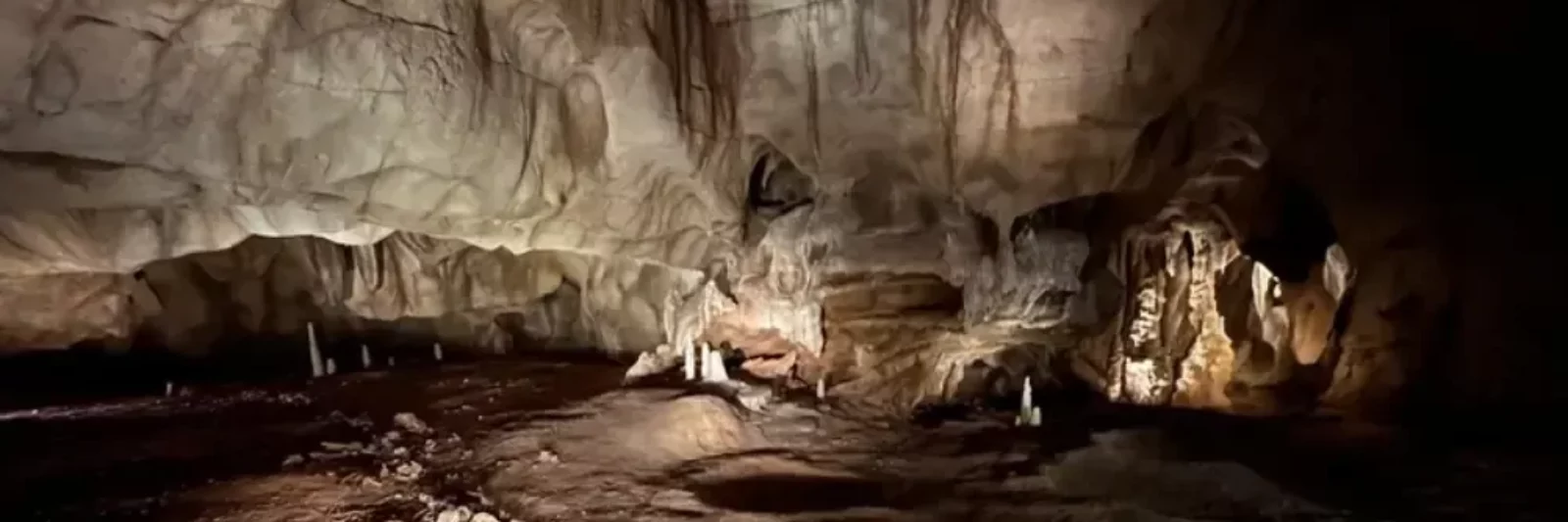
Picture this: a thin trickle of cold air escapes from a pile of rubble, on the side of a limestone cliff in the Ardèche gorges. Three cavers take an interest, clear the passage, slip through… and discover, intact, a sanctuary sealed for 20,000 years, covered with some of the oldest paintings ever made by human beings. This is the true story of Chauvet Cave, one of the most moving discoveries in archaeology. An absolute wonder, born in the Ardèche, very close to Mas Saint Antoine. Here is its story.
18 December 1994: the discovery that changed our view of prehistory
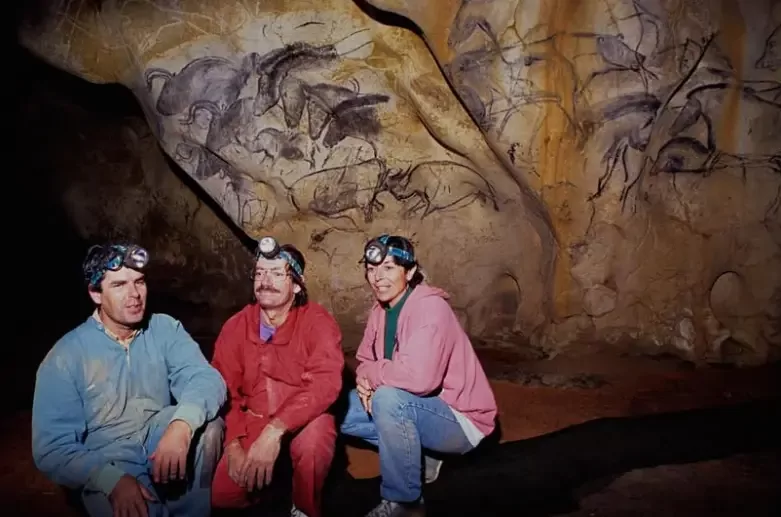
That day, in the commune of Vallon-Pont-d’Arc, three passionate cavers — Jean-Marie Chauvet, Éliette Brunel and Christian Hillaire — were exploring a stretch of cliffs they knew well. Their attention was caught by a tiny detail: a slight draught of air escaping from a cavity. For a caver, this breath is a promise: it signals a void, a space hidden behind the rock.
They cleared the narrow passage, descended into the dark… and entered a first chamber with glittering concretions. Then, further on, the incredible was revealed: the walls were covered with hundreds of animal drawings, of stunning precision and beauty, perfectly preserved. They understood at once that they had just touched something immense. The cave would bear the name of one of them: Chauvet.
Paintings 36,000 years old
What makes Chauvet Cave unique in the world is the age of its art. The oldest paintings date back to the Aurignacian period, about 36,000 years ago — nearly twice as old as those of Lascaux. They are, to this day, the oldest known figurative paintings of humanity.
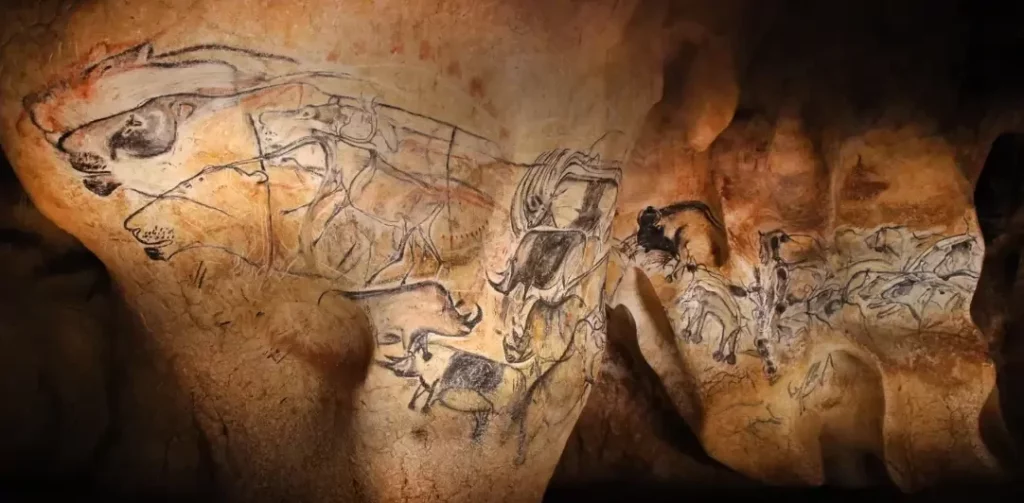
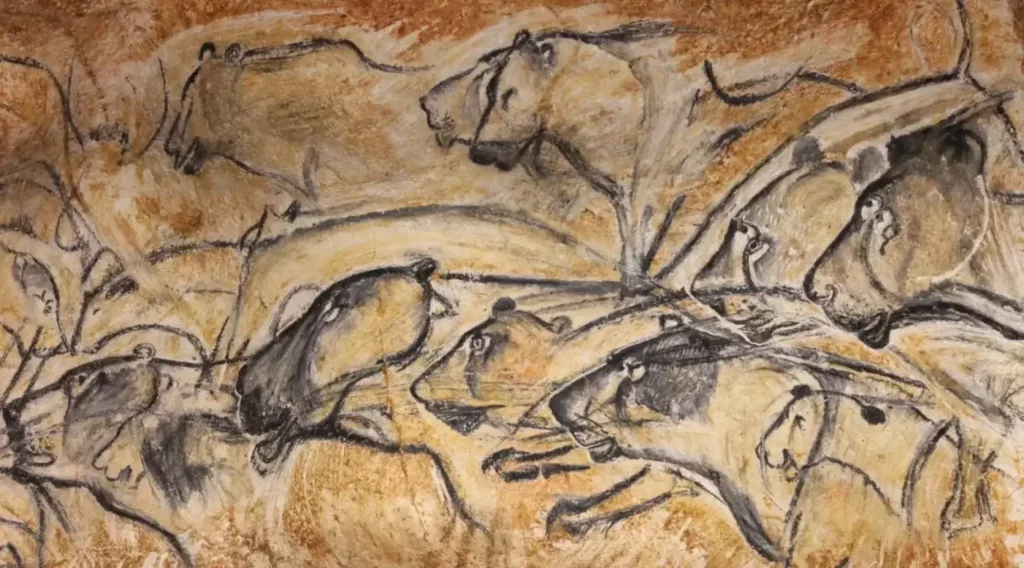
The cave is home to more than 1,000 drawings, including some 430 animal representations. And remarkably: the artists did not only depict hunted animals. They painted dangerous and impressive beasts — cave lions, woolly rhinoceroses, mammoths, bears, bison, aurochs — bearing witness to a world now vanished.
An artistic genius 36,000 years old
We often imagine prehistoric art as clumsy or primitive. Chauvet Cave proves the opposite, brilliantly. Its creators mastered techniques of astonishing sophistication: shading (estompe) to give relief, the combination of painting and engraving, remarkable anatomical precision, and even the suggestion of movement and perspective. Some frescoes, like the famous panel of the horses or that of the lions, have a power that rivals the greatest masters in the history of painting — 36,000 years before them.
The miracle of conservation
How could such fragile paintings cross the millennia intact? Thanks to a twist of fate: about 20,000 years ago, a rockfall hermetically sealed the entrance of the cave. Cut off from the outside world, sheltered from air, light and changing humidity, the cavity remained frozen in time — a true time capsule of the Palaeolithic. It is this accidental sealing that gave us, thousands of years later, a sanctuary in an exceptional state of preservation.
Why you cannot (and never will be able to) visit it
Here is the moving paradox of Chauvet Cave: this treasure of humanity, no one can visit it. From its discovery, the authorities decided never to open it to the public. The reason? The terrible lesson of Lascaux: there, the breath, heat and microbes brought by visitors had seriously degraded the paintings in just a few years (“the green disease”). For Chauvet, taking that risk was out of the question.
Only a few scientists, strictly supervised and for a limited number of days each year, are allowed to enter to study it. The real cave thus remains a sealed sanctuary, protected for the millennia to come. In 2014, UNESCO inscribed the Chauvet-Pont d’Arc decorated cave on the World Heritage list, confirming its universal value.
So how can you approach this wonder?
While the original cave is inaccessible, its genius is not lost to the public. A few kilometres from the original, a full-scale replica was created, the Caverne du Pont-d’Arc (Chauvet Cave 2), an artistic and scientific feat that faithfully reconstructs the frescoes and atmosphere of the real cave. It is this one that you visit — and it lets you feel, without damaging the original, all the power of this art.
To prepare this visit, see our practical guide to Chauvet Cave 2, with access information, prices and booking.
A wonder a stone’s throw from Mas Saint Antoine
Chauvet Cave is located near Vallon-Pont-d’Arc, at the entrance to the Ardèche gorges, about fifty minutes from Mas Saint Antoine. Staying here means sleeping in the heart of a land that saw the birth of one of humanity’s very first masterpieces. Find our accommodations on the our cottages in the Ardèche page and our visit ideas in Le Mag du Mas.
In conclusion
- Chauvet Cave was discovered on 18 December 1994 by three cavers following a draught of air.
- Its paintings, about 36,000 years old, are the oldest known figurative paintings in the world.
- More than 1,000 drawings, ~430 animals, of stunning artistic mastery (shading, perspective, movement).
- A rockfall sealed it 20,000 years ago, ensuring exceptional conservation.
- Closed forever to the public (the lesson of Lascaux), UNESCO-listed in 2014; you visit its replica, Chauvet Cave 2.
A draught of air, three enthusiasts, and 36,000 years of history resurfacing: Chauvet Cave remains one of the most moving gifts the Ardèche has offered the world.
✍️ Article written by Bernard Favre, owner of Mas Saint Antoine.
Frequently asked questions
When and by whom was Chauvet Cave discovered?
Chauvet Cave was discovered on 18 December 1994 by three cavers: Jean-Marie Chauvet, Éliette Brunel and Christian Hillaire. They were drawn by a slight draught of air signalling a hidden cavity, near Vallon-Pont-d’Arc in the Ardèche.
How old are the paintings in Chauvet Cave?
The oldest paintings date back about 36,000 years (Aurignacian period). They are the oldest known figurative paintings in the world, nearly twice as old as those of Lascaux.
Can you visit the real Chauvet Cave?
No. The original cave has never been open to the public and never will be, in order to preserve its paintings (the lesson of Lascaux’s degradation). Only a few scientists access it, in a very controlled way. The public can visit its full-scale replica, Chauvet Cave 2.
Why are the paintings so well preserved?
About 20,000 years ago, a rockfall hermetically sealed the cave’s entrance. Isolated from outside air and light, the cavity remained frozen in time, which allowed exceptional preservation of the works.
Which animals are depicted in Chauvet Cave?
More than 1,000 drawings and about 430 animal representations are featured. They include cave lions, woolly rhinoceroses, mammoths, bears, bison, aurochs and horses — many of them dangerous and now-extinct species.
Is Chauvet Cave a UNESCO site?
Yes. The Chauvet-Pont d’Arc decorated cave was inscribed on the UNESCO World Heritage list on 22 June 2014, in recognition of its exceptional universal value for prehistoric art.
Where is Chauvet Cave in relation to Mas Saint Antoine?
Chauvet Cave is located near Vallon-Pont-d’Arc, at the entrance to the Ardèche gorges, about 50 minutes from Mas Saint Antoine. The visitable replica (Chauvet Cave 2) is in the same area.
Prepare your stay in the Ardèche
Ideally located in southern Ardèche, Mas Saint Antoine is the perfect base to explore the region: 6 independent cottages, a 13×6 m saltwater pool, a large peaceful park. Rated 4.9/5 from 137 reviews, selected by Petit Futé 2026.
A question? Call Héléna at 06 29 11 41 88
Avis google

Le logement est nickel, très agréable et parfaitement entretenu\. La piscine est top, un vrai bonheur pour profiter et se détendre \! ☀️🏊♀️
Les conseils pour les activités et les visites étaient vraiment hyper adaptés à nos envies, ce qui nous a permis de découvrir de très chouettes endroits\. Le lieu est vraiment sympa, calme et agréable\.
Une adresse que nous recommandons les yeux fermés \+\+\+ \! Merci encore pour cet accueil et ce super séjour, nous reviendrons avec grand plaisir \! 😊
Famille Descampiaux

Nous qui souhaitions nous reposer et prendre du bon temps, nous avons été plus que servis.
Notre chalet "lavande", proposait tout le nécessaire, à l ombre des arbres, nous avons pu nous détendre bercés par le chant des cigales.
Après les activités sportives, visites...quel bonheur de venir se rafraîchir dans cette magnifique piscine.
Nous avons vraiment apprécié l'accueil et la gentillesse de nos hôtes.
Quel bonheur de ne pas se soucier de draps, de serviettes, torchons....
En bref, pari réussi, du repos, des activités et de la convivialité...
Merci pour ce beau séjour et ces échanges.
Nous reviendrons !
Élisabeth et Patrick.

Le gîte est top, conforme à la description.
Les propriétaires sont très sympas et de très bons conseils pour les visites, les restos et activités à faire aux alentours.
Nous sommes venus avec notre chien qui a pu se déplacer librement dans la propriété, en toute sécurité.
Location à recommander !

Un très bon accueil des propriétaires.
Des prestations ( paella, canoë....),que nous avons tous apprécié.
Des couchages confortables.
Nous reviendrons avec grand plaisir.
Merci

Concernant les hébergements et les infrastructures, tout est parfait. On ne manque de rien et le lieu est magnifique.
Encore merci pour ce week-end qui fût des plus agréable !

Le domaine est superbe, très bien entretenu, au calme, au cœur de l’Ardèche méridionale, avec une vraie ambiance conviviale et familiale. Les différents gîtes permettent à chacun d’avoir son espace tout en gardant un vrai lieu de rassemblement pour partager les repas et les activités.
Un immense merci également aux propriétaires pour leur disponibilité, leur écoute et leur gentillesse tout au long de l’organisation. Nous avons été très bien accompagnés avant le week-end avec de nombreux conseils utiles, aussi bien pour les prestataires que pour l’organisation générale de l’événement.
Tout a été simple, fluide et agréable. Les recommandations données sur place étaient excellentes et nous ont permis de construire un week-end vraiment réussi.
Le cadre est idéal pour ce type de rassemblement familial ou amical : piscine, nature, tranquillité, nombreux hébergements et beaucoup d’activités à faire dans les environs.
Nous gardons un très beau souvenir de ce week-end et nous recommandons le Mas Saint-Antoine sans hésitation.
**La seule petite contrainte du week-end concerne la gestion des déchets, puisqu’il n’y a pas encore de bacs d’ordures ménagères ou de tri directement sur le domaine et qu’il faut se rendre au village. Cela ne nous a pas posé de véritable problème, mais ce serait un vrai plus à l’avenir.


Bref un endroit au top que nous recommandons vivement

Le lieu est magnifique, avec une très belle vue et très calme.
La propriétaire a été charmante et à l'écoute de nos besoins quels qu'ils soient; un climat de confiance s'est vite installé.
Le lieu est très accessible et les parties communes pour se réunir sont très bien équipées.
La literie est bonne et les chambres propres.
Je recommande

Le cadre extérieur est également très appréciable : piscine, forêt, ping-pong, terrain de pétanque et grande terrasse pour profiter encore un peu du soleil d’automne ☀️
Merci Hélène et Bernard pour votre accueil chaleureux!
Merci également au traiteur So’ brunch de nous avoir livré à domicile pour régaler nos papilles tout le week-end!
Une expérience réussie! 🥳

L'espace piscine est vraiment super avec des nombreuses assises si vous êtes un grand groupe.
Tous les gîtes sont très propres et très bien équipés. Pas de plaintes des invités sur la literies en tout cas! Petit plus : les lits étaient fait à l’arrivée et les serviettes à disposition sur les lit.
Nous avons pu également voir de superbes couchés de soleil sur la vallée. Sans oublier la vue dégagée sur le mont ventoux.
Une très chouette adresse : j’y retournerai avec grand plaisir ! Pourquoi pas les 35 ans !


Bernard et sa femme sont adorables, humains, serviable et très à l'écoute.
C'est un gîte familial, tranquille et agréable.
Et il n'y a pas de moustiques ! 😅
Nous avons passé un excellent séjour.
Si nous revenons en Ardèche ça sera ici, merci encore pour tout 🙏


Un accueil très chaleureux d’Hélène et Bernard qui nous ont indiqué plusieurs sites à visiter. On n’oublie pas Djingo, le super copain de notre chienne.


Gîte de l’olivier pour notre séjour très propre et très bien équipé , pensez juste au tire bouchon ^^ seule petit bémol pour la personne dormant dans le salon la VMC peut être bruyante pour une personne ayant le sommeil léger sinon rien à redire nous reviendrons si nous passons dans le coin ! Merci pour votre accueil

Patricia et stéphane

Rien à redire! Il nous tarde de revenir.


Notre chien aussi a apprécié le séjour, il a pu navigué à son aise sur le domaine.
Les propriétaires sont très sympathiques et arrangeants.
Nous avons beaucoup aimé notre semaine au Mas et nous recommandons vivement cette adresse.


Je recommande fortement

Logements/cuisines et extérieurs très bien équipés et adaptés aux enfants!
Merci pour l’accueil :-)

Des propriétaires des plus accueillants, toujours à l'écoute de nos remarques et de notre bien être.
Beaucoup d'activités à faire autour du Mas saint antoine
on pense déjà à notre prochain séjour au Mas, c'est un lieu à connaître et à découvrir sans attendre, vous passerez un séjour plus que reposant
merci encore aux propriétaires du Mas Saint Antoine , lieu incontournable

La piscine est juste splendide dans un écrin de verdure.
Quant aux propriétaires ils sont adorables et prêt à vous aider et vous conseiller. Superbe semaine

Nous conseillons le lieu car idéalement situé pour circuler et visiter cette belle région.

Très belle piscine avec pergolas pour éviter les coups de soleil.
Les propriétaires sont à l'écoute,
disponibles et de très bons conseils pour découvrir la région.
Maxime et Laetitia

Les propriétaires sont prévenant
Piscine gîte WiFi dans les chalets
Vue splendide


Nous avons pu partager de très bons moments avec les hôtes, qui sont de très bons conseils sur ce qu'il y a à faire et à découvrir aux alentours.
Le cadre et le logement sont magnifiques, un vrai havre de paix où il fait bon de se retrouver entre amis ou en famille
Le Mas Saint Antoine est idéalement placé pour profiter de toutes les activités touristiques et sportives
La piscine avec vue est sécurisée et splendide, la réalité est conforme aux photos, tout est très bien équipé et choisi avec goût
Merci à nos hôtes pour l'accueil, nous reviendrons avec plaisir !


Très vaste et parfaitement équipé.
Accueil cordial .
Gite à recommander.

Un grand merci aux hôtes qui nous ont très bien reçu. Le cadre du mas saint Antoine est idéal pour des retrouvailles familiales, sécurisé et très bien équipé.
Les gîtes sont décorés avec goût, propres et fonctionnels. La piscine, les terrains de pétanques, la table de ping-pong sont un vrai plus. Nous avons même eu la possibilité de louer un karaoke!
Toute la famille, des petits aux grands garderons un super souvenir de cet endroit. Nous gardons précieusement l’adresse.
Merci beaucoup et à bientôt !
Julie et toute sa famille :)


Les parties de pétanques et de ping-pong a l'ombre des arbres auraient pu durer jusqu'au lendemain si les enfants qui se sont éclatés ne vennaient pas nous interrompre😁.
Nous n'avons pas pu profiter de la piscine car la température ne le permettait pas, mais je ne doute pas que ce doit être un délice en été.
Un seul regret: ne pas avoir été initié par Bernard à la recherche de truffes dans sa truffière privée...😆
Nous reviendrons, c'est certain, et nous vous recommanderons vivement et sincèrement!
Longue vie au Mas St-Antoine et merci Elena et Bernard d'offrir un lieu magique.


Je recommande


I recommend this well located and quiet place.

Logement impeccable, décoré avec goût, et fonctionnel.
Notre petite famille à pu profiter d’un séjour agréable , et dépaysant.
La piscine avec vu imprenable était un très apprécié.
Petit plus: notre chien a pu profiter du voyage également…
Merci à vous.
Romain Juliette et les enfants.

,


Les propriétaires sont extrêmement sympathiques, a l'écoute et très serviables, nous y reviendrons a coup sûr


Une piscine au top du top ,les propriétaires sont très accueillants et sympathique
Nous y reviendrons avec plaisir


Perfect welcome in joy and good humor, beautiful place and the chalets are good. The swimming pool is superb and equipped. The tenants informed us well about the surroundings. This place is magnificent !!!


Nous avons pu profiter de la piscine mais aussi des alentours. Nous regrettons de n’être pas restés davantage pour profiter encore de la région.

